




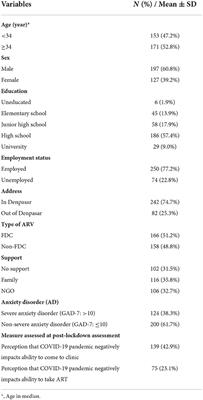
Factors associated with anti-retroviral therapy adherence among patients living with HIV during the COVID-19 pandemic: A cross-sectional study
Source : https://www.frontiersin.org/articles/10.3389/fpsyt.2022.824062/full
BackgroundThe coronavirus disease (COVID-19) pandemic causes fear and anxiety symptoms on some vulnerable populations such as patients living with human immunodeficiency virus (HIV) (PLWH).
Conclusions: During the COVID-19 pandemic, factors associated with high ART adherence among PLWH attending the Hospital of Wangaya in Denpasar, Bali, Indonesia were employment status, ART type [non-fixed dose combination (FDC)], family support, and the perception that the COVID-19 pandemic negatively impacts the ability to attend clinics and to...
Nutritional aberration and related morphological disorders among patients with human immunodeficiency virus infection on combination antiretroviral therapy (cART) in Ghana: A retrospective study - PubMed
Source : https://pubmed.ncbi.nlm.nih.gov/36090208/
1 Department of Nutrition and Dietetics, School of Allied Health Sciences, University of Health and Allied Sciences, Ho, Ghana. 2 Department of Medical Laboratory Sciences, School of Allied Health Sciences,...
Conclusions: High malnutrition, lipodystrophy and muscle wasting exist in PLHIV on cART in the Bia-West District. These adverse nutritional effects may be modulated by disease severity, ARV medication and duration.
Evaluating Islatravir Administered Via Microneedle Array Patch for Long-Acting HIV Pre-exposure Prophylaxis Using Physiologically Based Pharmacokinetic Modelling - PubMed
Source : https://pubmed.ncbi.nlm.nih.gov/36178586/
The ISL PBPK model successfully predicted ISL and ISL-TP pharmacokinetics across a range of orally administered regimens. The integrated intradermal PBPK model outlined optimal MAP dose and nanoparticle release rates...
Conclusions: The ISL PBPK model successfully predicted ISL and ISL-TP pharmacokinetics across a range of orally administered regimens. The integrated intradermal PBPK model outlined optimal MAP dose and nanoparticle release rates for effective ISL-TP concentrations up to 12 months, providing justification for further investigation of ISL as a...

Transfer of antiretroviral drugs into breastmilk: a prospective study from the Swiss Mother and Child HIV Cohort Study
Source : https://academic.oup.com/jac/advance-article/doi/10.1093/jac/dkac337/6731709?login=false
Until recently, guidelines in high-income settings advised women living with HIV not to breastfeed and to give formula milk to their babies. Due to the important health advantages of breastfeeding...
Conclusions: ARVs were transferred to a variable extent in breastmilk. Nevertheless, the estimated daily ARV dose from breastfeeding remained low. Differential ARV exposure was observed in breastfed infants with some ARVs being below/above their effective concentrations raising the concern of resistance development if HIV infection occurs. More...
Progress towards the UNAIDS 90-90-90 targets among persons aged 50 and older living with HIV in 13 African countries - PubMed
Source : https://pubmed.ncbi.nlm.nih.gov/36176030/
While OPLWH in these 13 countries were slightly more likely than younger people to be aware of their HIV-positive status (first 90), this target was not achieved in most countries....
Conclusions: While OPLWH in these 13 countries were slightly more likely than younger people to be aware of their HIV-positive status (first 90), this target was not achieved in most countries. However, OPLWH achieved treatment (second 90) and VL suppression (third 90) targets in more countries than PLWH