

/>
Relevance: Non–LDLR-dependent therapies approved for lowering LDL cholesterol in patients with HoFH include lomitapide, a microsomal transferase protein inhibitor; evolocumab, an angiopoietin like 3 protein inhibitor; and LDL apheresis. Lomitapide can effectuate dose-dependent LDL cholesterol lowering. In an open-label, single-arm study of...
Share




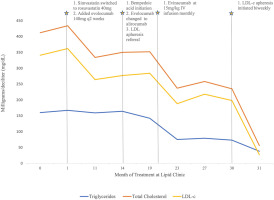
Implementation of Novel Lipid Therapies in a Refractory Heterozygous Familial Hypercholesterolemia Patient With Atherosclerotic Disease
Source : https://www.sciencedirect.com/science/article/pii/S2666084922005198?via=ihub
Compound heterozygous familial hypercholesterolemia patients are phenotypically similar to homozygous familial hypercholesterolemia patients, present with significant elevations of low-density lipoprotein cholesterol, and are at risk of cardiovascular disease. Although new...
Conclusions/Relevance: Compound heterozygous familial hypercholesterolemia patients are phenotypically similar to homozygous familial hypercholesterolemia patients, present with significant elevations of low-density lipoprotein cholesterol, and are at risk of cardiovascular disease. Although new treatment options are emerging, the stepwise...
Share

Additive effects of ezetimibe, evolocumab, and alirocumab on plaque burden and lipid content as assessed by intravascular ultrasound: A PRISMA-compliant meta-analysis
Source : https://www.ncbi.nlm.nih.gov/pmc/articles/PMC9575789/
Di Liang, MPhil, a Chang Li, MPhil, a Yanming Tu, MPhil, a Zhiyong Li, Mphil, a and Ming Zhang, MD a, * The additive effects of ezetimibe, evolocumab or alirocumab...
Conclusions: The addition of ezetimibe to statin therapy may further reduce plaque and lipid burdens but may not modify plaque composition. Although current evidence supports a similar impact from the addition of PCSK9 inhibitors to statin therapy, more evidence is needed to confirm such an effect.
Share
-
 Lipid Management Connect3yrKey Points • Source: Medicine • Conclusion: “The addition of ezetimibe to statin therapy may further reduce plaque and lipid burdens but may not modify plaque composition. Although current evidence supports a similar Show More
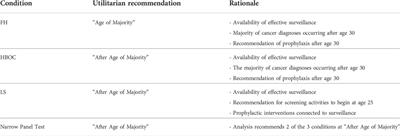
Population genomic screening: Ethical considerations to guide age at implementation
Source : https://www.frontiersin.org/articles/10.3389/fgene.2022.899648/full
Currently, most genetic testing involves next generation sequencing or panel testing, indicating future population-based screening will involve simultaneous testing for multiple disease risks (called here "panel testing"). Genomic screening typically...
Relevance: We conducted an ethical analysis utilizing a hypothetical “narrow” panel test comprised of the CDC Tier 1 Genomic Applications: Familial Hypercholesterolemia (FH), increases individuals’ cardiovascular risk due to elevated low-density lipoprotein (LDL) cholesterol levels; Hereditary Breast and Ovarian Cancer (HBOC), increases...
Share

Statin use in patients with hormone receptor-positive metastatic breast cancer treated with everolimus and exemestane - PubMed
Source : https://pubmed.ncbi.nlm.nih.gov/36263515/
doi: 10.1002/cam4.5369. Online ahead of print. 1 Division of Hemato-Oncology, Department of Internal Medicine, Korea University Guro Hospital, Korea University College of Medicine, Seoul, Republic of Korea. 2 Smart Healthcare...
Conclusions: "Conclusion: Statins may have synergistic effects with endocrine therapy with the mTOR inhibitor everolimus, and improve survival in patients with HR metastatic breast cancer."
Share