
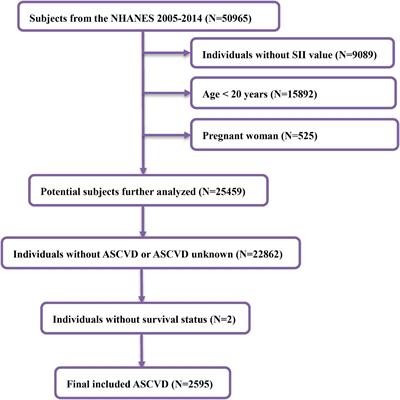
Association of the systemic immune-inflammation index with all-cause mortality in patients with arteriosclerotic cardiovascular disease
Source : https://www.frontiersin.org/articles/10.3389/fcvm.2022.952953/full
ObjectiveSystemic immune-inflammation index (SII), derived from blood cell counts of circulating platelets, neutrophils, and lymphocytes, has been identified as a novel inflammatory and prognostic marker. However, the clinical value of...
Conclusions: An association was detected between the baseline ln-SII and all-cause mortality in a United States ASCVD population. Increased SII is associated with poor survival in individuals with ASCVD.
Share





Estimated Atherosclerotic Cardiovascular Disease Risk: Disparities and Severe COVID-19 Outcomes (from the National COVID Cohort Collaborative) - PubMed
Source : https://pubmed.ncbi.nlm.nih.gov/36175254/
Although cardiovascular disease risk factors relate to COVID-19, the association of estimated atherosclerotic cardiovascular disease (ASCVD) risk with severe COVID-19 is not established. We examined the relation of the pooled-cohort...
Conclusions: Although further research is needed, the 10-year ASCVD risk score in adults ages 40 to 79 years may be used to identify those who are at highest risk for COVID-19 complications and for whom more intensive treatment may be warranted.
Share
Novel Insights into the Management of Patients with Very High Cardiovascular Risk Eligible for PCSK9 Inhibitor Treatment: Baseline Findings from the PERI-DYS Study - Cardiovascular Drugs and Therapy
Source : https://link.springer.com/article/10.1007/s10557-022-07386-0
Aim The PERI-DYS study aims to characterize two groups of patients with dyslipidaemia at very high CV risk: PCSK9i receivers and patients qualifying for but not receiving PCSK9i. Methods This...
Conclusions: PCSK9i receivers are characterized by higher baseline LDL-C and a higher portion of statin intolerance compared to those qualified for but not-receiving PCSK9i treatment. On-treatment, LDL-C was lower in PCSK9i receivers. Ongoing follow-up will determine the prognostic importance of these findings.
Share

Lomitapide ameliorates middle cerebral artery occlusion-induced cerebral ischemia/reperfusion injury by promoting neuronal autophagy and inhibiting microglial migration - PubMed
Source : https://pubmed.ncbi.nlm.nih.gov/36052650/
Lomitapide is a lipid-lowering drug, and this is the first study to explore its protective effect on ischemic nerve injury in vitro and in vivo. Our results suggest that lomitapide...
Conclusion: Lomitapide is a lipid-lowering drug, and this is the first study to explore its protective effect on ischemic nerve injury in vitro and in vivo. Our results suggest that lomitapide can be repositioned as a potential therapeutic drug for the treatment of stroke.
Share

The First Report of a Real-World Experience With a PCSK9 Inhibitor in a Large Familial Hyperlipidemia and Very-High-Risk Middle Eastern Population
Source : https://www.clinicaltherapeutics.com/article/S0149-2918(22)00285-5/fulltext
Evolocumab, a monoclonal inhibitor of proprotein convertase subtilisin/kexin 9, has been shown to reduce proatherogenic lipoproteins in patients with or without familial hypercholesterolemia (FH), diabetes mellitus, or atherosclerotic cardiovascular disease...
Implications: This study is the first from the Middle East and North Africa region that reports the real-world efficacy of evolocumab in a mixed risk population of individuals with FH and other non-FH indications. Clinically meaningful and sustained reductions in LDL-C, TG, and cholesterol ratios were observed after evolocumab initiation. Few...
Share