


Targeting PCSK9 to tackle cardiovascular disease
Source : https://www.sciencedirect.com/science/article/pii/S0163725823001444?via=ihub
Lowering blood cholesterol levels efficiently reduces the risk of developing atherosclerotic cardiovascular disease (ASCVD), including coronary artery...
Conclusion: The discovery of the PCSK9 gene and associated GOF/LOF mutations provided the foundation for a new treatment strategy targeting PCSK9 to tackle ASCVD. PCSK9 inhibitors have been developed in record time, and FDA-approved antibodies targeting PCSK9 have already shown clinically efficient LDL-C lowering and ASCVD risk reduction...
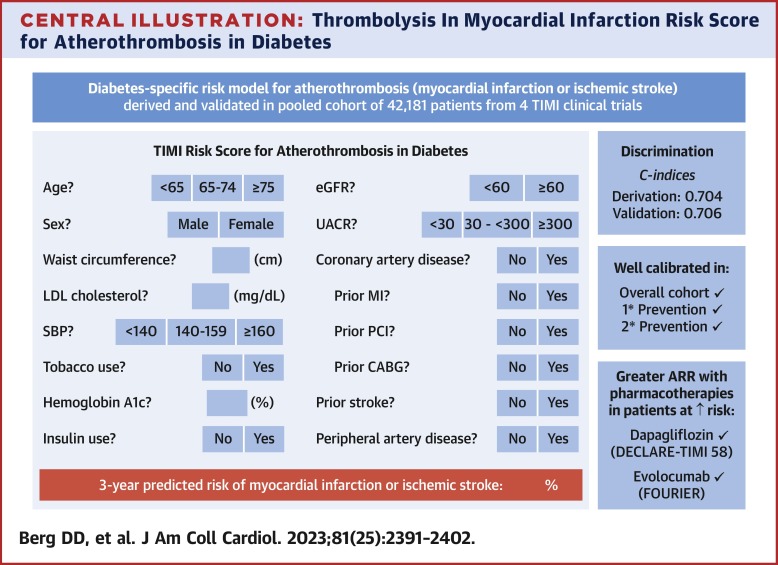
Assessment of Atherothrombotic Risk in Patients With Type 2 Diabetes Mellitus
Source : https://www.sciencedirect.com/science/article/pii/S0735109723055006?via=ihub
Risk of atherothrombotic events is not uniform in patients with type 2 diabetes mellitus (T2DM). Tailored risk assessment may help guide selection of ...
Conclusions: We developed and validated a risk score for atherothrombotic events, leveraging 16 routinely assessed clinical variables in patients with T2DM. The score has the potential to improve risk assessment and inform clinical decision-making.
Sex-Specific Impact of Body Weight on Atherosclerotic Cardiovascular Disease Incidence in Individuals With and Without Ideal Cardiovascular Health - PubMed
Source : https://pubmed.ncbi.nlm.nih.gov/37345817/
Background The impact of an elevated body mass index (BMI) on atherosclerotic cardiovascular disease (ASCVD) risk in individuals who are metabolically healthy is debated. We investigated the respective contributions of...
Conclusions: In women and men in the UK Biobank, the relationship between the BMI and ASCVD incidence in healthy individuals was inconsistent, whereas cardiovascular risk factors strongly predicted ASCVD incidence in all BMI categories. Assessing lifestyle and cardiometabolic risk factors as well as body fat distribution indices may help...
Is there benefit to adding ezetimibe to a statin for the secondary prevention of CVD? - PubMed
Source : https://pubmed.ncbi.nlm.nih.gov/37339492/
YES. In patients with known cardiovascular disease (CVD), ezetimibe with a statin decreases major adverse cardiovascular events (MACE) but has no effect on all-cause and cardiovascular mortality, compared to a...
Conclusions/Relevance: In patients with known cardiovascular disease (CVD), ezetimibe with a statin decreases major adverse cardiovascular events (MACE) but has no effect on all-cause and cardiovascular mortality, compared to a statin alone (strength of recommendation [SOR], A; meta-analysis of randomized controlled trials [RCTs] including 1...
Impact of alirocumab/evolocumab on lipoprotein (a) concentrations in patients with familial hypercholesterolaemia: a systematic review and meta-analysis of randomized controlled trials - PubMed
Source : https://pubmed.ncbi.nlm.nih.gov/37335067/
Anti-PCSK9 drugs (alirocumab and evolocumab) may be effective as therapy for reducing serum Lp(a) levels in FH, and no differences were observed in treatment durations, participant characteristics, and other aspects...
Conclusions: Anti-PCSK9 drugs (alirocumab and evolocumab) may be effective as therapy for reducing serum Lp(a) levels in FH, and no differences were observed in treatment durations, participant characteristics, and other aspects of the 2 types of PCSk9 inhibitors. However, further experimental studies and RCTs are warranted to clarify the...