
Smoking and diabetes attenuate beneficial effects of PSCK9 inhibitors on arterial wall properties in patients with very high lipoprotein (a) levels
Source : https://www.sciencedirect.com/science/article/pii/S2667089522000207?via=ihub
Elevated lipoprotein (a) (Lp(a)) and low-density lipoprotein cholesterol levels (LDL-C) are significant residual risk factors for cardiovascular event...
Conclusion: These data show that for patients with CAD and high Lp(a) levels, beneficial effects of PCSK9 inhibitors on the arterial wall properties can be attenuated by specific risk factors, such as smoking and diabetes.
Share




-
 Lipid Management Connect2yrKey Points • Source: Atherosclerosis Plus • Conclusion: “These data show that for patients with CAD and high Lp(a) levels, beneficial effects of PCSK9 inhibitors on the arterial wall properties can be attenuated by Show More

Haematological Parameters in People with Atherosclerotic Cardiovascular Disease versus Those Who are Only at Risk for Cardiovascular Disease: A Comparative Cross-Sectional Study
Comparing the pattern of hematological parameters in people with established atherosclerotic cardiovascular disease (ASVD) versus people with ASCVD risks alone
Results: The ASCVD-risk group had significantly higher mean platelet volume (MPV), which was associated with the presence of the risk. Furthermore, hs-CRPs show a significant correlation with MPV in a correlation analysis of highly sensitive C-reactive protein (hs-CRP) with hematological parameters. Thus, using these affordable, routinely...
Share

Disparities in PCSK9 Initiation Among US Veterans with Peripheral Arterial Disease or Cerebrovascular Disease - PubMed
Source : https://pubmed.ncbi.nlm.nih.gov/36947397/
Adjusted for LDL-C levels, PAD and CeVD patients are much less likely to receive PCSK9i therapy. Despite low co-pay, PCSK9i initiation rates among US veterans, nationwide, is low, with household...
Conclusions: Adjusted for LDL-C levels, PAD and CeVD patients are much less likely to receive PCSK9i therapy. Despite low co-pay, PCSK9i initiation rates among US veterans, nationwide, is low, with household income and community deprivation appearing to predict PCSK9i use.
Share
Targeting PCSK9 to tackle cardiovascular disease
Source : https://www.sciencedirect.com/science/article/pii/S0163725823001444?via=ihub
Lowering blood cholesterol levels efficiently reduces the risk of developing atherosclerotic cardiovascular disease (ASCVD), including coronary artery...
Conclusion: The discovery of the PCSK9 gene and associated GOF/LOF mutations provided the foundation for a new treatment strategy targeting PCSK9 to tackle ASCVD. PCSK9 inhibitors have been developed in record time, and FDA-approved antibodies targeting PCSK9 have already shown clinically efficient LDL-C lowering and ASCVD risk reduction...
Share
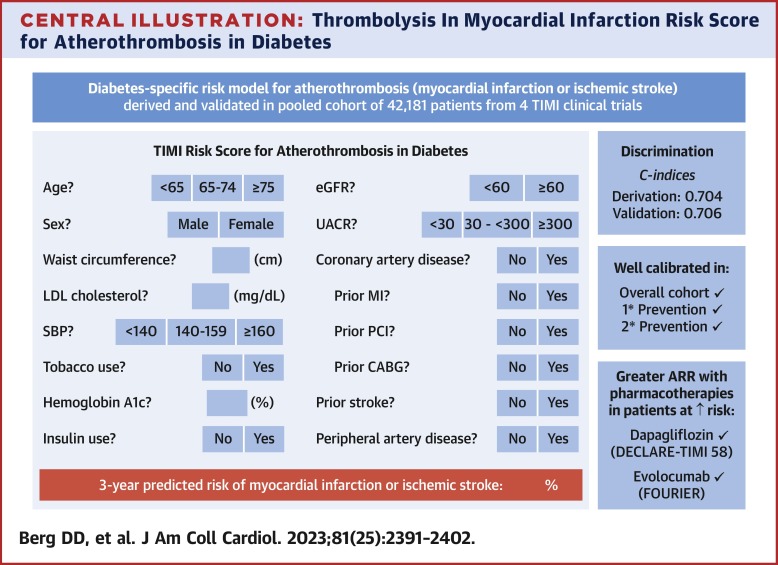
Assessment of Atherothrombotic Risk in Patients With Type 2 Diabetes Mellitus
Source : https://www.sciencedirect.com/science/article/pii/S0735109723055006?via=ihub
Risk of atherothrombotic events is not uniform in patients with type 2 diabetes mellitus (T2DM). Tailored risk assessment may help guide selection of ...
Conclusions: We developed and validated a risk score for atherothrombotic events, leveraging 16 routinely assessed clinical variables in patients with T2DM. The score has the potential to improve risk assessment and inform clinical decision-making.
Share