

Appropriateness of Dyslipidemia Management Strategies in Post-Acute Coronary Syndrome: A 2023 Update - PubMed
Source : https://pubmed.ncbi.nlm.nih.gov/37623860/
It has been consistently demonstrated that circulating lipids and particularly low-density lipoprotein cholesterol (LDL-C) play a significant role in the development of coronary artery disease (CAD). Several trials have been...
Conclusions/Relevance: This review aims to discuss the possible lipid-lowering strategies in post-ACS and to identify those patients who might benefit most from more powerful treatments and up-to-date management.
Share





Causal relationship between PCSK9 inhibitor and autoimmune diseases: a drug target Mendelian randomization study - Arthritis Research & Therapy
Source : https://arthritis-research.biomedcentral.com/articles/10.1186/s13075-023-03122-7
Background In addition to decreasing the level of cholesterol, proprotein convertase subtilis kexin 9 (PCSK9) inhibitor has pleiotropic effects, including immune regulation. However, the impact of PCSK9 on autoimmune diseases...
Conclusions: PCSK9 inhibitor significantly reduced the risk of SLE but increased the risk of asthma and CD. In contrast, HMGCR inhibitor may be a risk factor for RA, asthma, and CD.
Share
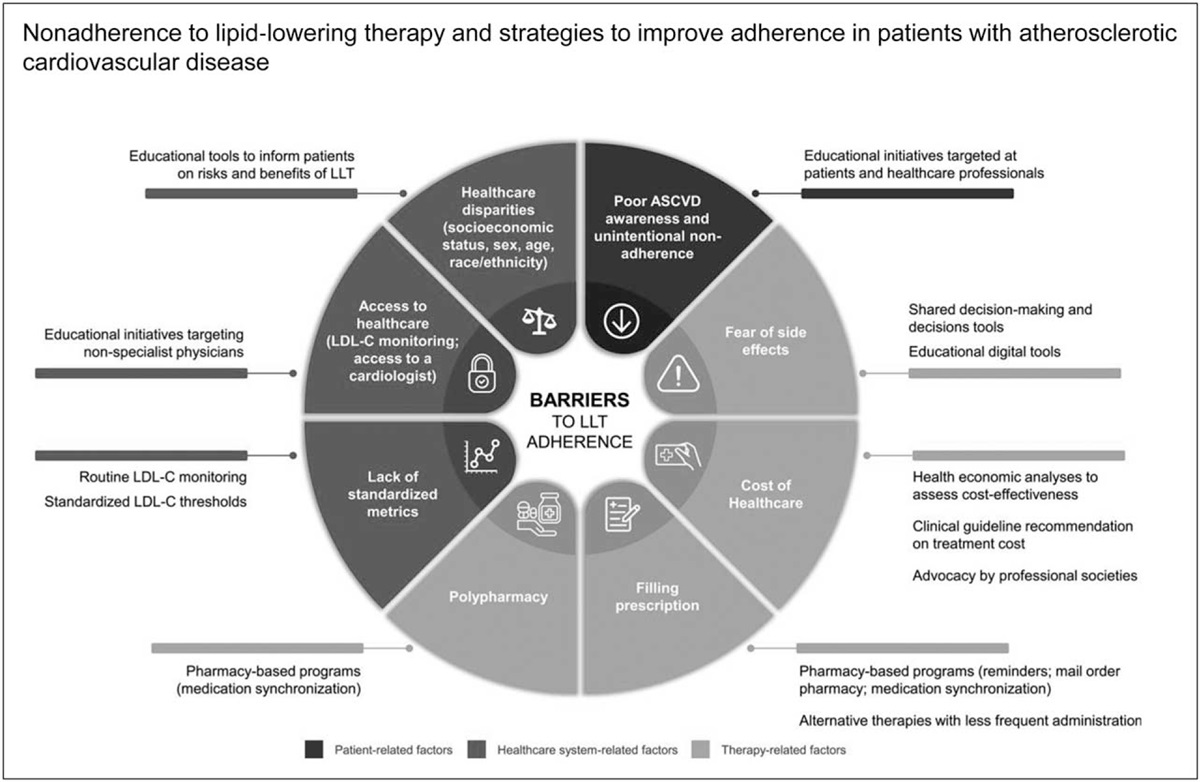
Strategies of improving adherence to lipid-lowering therapy in patients with atherosclerotic cardiovascular disease
Source : https://journals.lww.com/co-lipidology/abstract/9900/strategies_of_improving_adherence_to.45.aspx
agement in patients with ASCVD focusing on the provider, patient, and system level. Recent findings At a provider level, under-prescribing of statin intensity due most often to statin intolerance, clinical...
Summary: To improve cholesterol management in ASCVD patients will require an integrated approach targeting the provider, the patient and the system. There is a need for further education of clinicians on the importance of intensive LDL-C lowering in ASCVD patients and greater use of nonstatin LDL-C-lowering therapies for those patients on a...
Share

Targeting PCSK9 and Beyond for the Management of Low-Density Lipoprotein Cholesterol - PubMed
Source : https://pubmed.ncbi.nlm.nih.gov/37568484/
Reducing low-density lipoprotein cholesterol (LDL-C) levels is crucial to the prevention of atherosclerotic cardiovascular disease (ASCVD). However, many patients, especially those at very high ASCVD risk or with familial hypercholesterolemia...
Conclusions/Relevance: These strategies demonstrate significant LDL-C reductions and improved cardiovascular outcomes, offering potential for optimal LDL-C control and reduced ASCVD risk. By addressing the limitations of statin monotherapy, these approaches provide new management options for elevated LDL-C levels.
Share

Integrated omics approach for the identification of HDL structure-function relationships in PCSK9-related familial hypercholesterolemia - PubMed
Source : https://pubmed.ncbi.nlm.nih.gov/37550151/
Several metrics of anti-atherogenic HDL functionality are altered in FH-PCSK9 patients paralleled by distinct compositional alterations. These data provide a first-ever overview of the impact of GOF PCSK9 genetic variants...
Conclusion: Several metrics of anti-atherogenic HDL functionality are altered in FH-PCSK9 patients paralleled by distinct compositional alterations. These data provide a first-ever overview of the impact of GOF PCSK9 genetic variants on structure-function relationships in HDL.
Share