

Adverse event profiles of PCSK9 inhibitors alirocumab and evolocumab: data mining of the FDA Adverse Event Reporting System - PubMed
Source : https://pubmed.ncbi.nlm.nih.gov/35818959/
doi: 10.1111/bcp.15460. Online ahead of print. 1 Research Division of Clinical Pharmacology, the First Affiliated Hospital of Nanjing Medical University, Nanjing, Jiangsu, China. 2 Department of Respiratory, Wuxi No.5 People's...
Conclusion: Data mining of the FAERs is useful for examining PCSK9 inhibitor-induced AEs. Herein, our findings were largely consistent with clinical experience and could help clinicians improve the safety of PCSK9 inhibitors in clinical practice.
Share





Familial Hypercholesterolemia
Source : https://www.ncbi.nlm.nih.gov/books/NBK174884/
Familial hypercholesterolemia (FH) is characterized by significantly elevated low-density lipoprotein cholesterol (LDL-C) that leads to atherosclerotic plaque deposition in the coronary arteries and proximal aorta at an early age and...
Relevance: Familial hypercholesterolemia (FH) is characterized by significantly elevated low-density lipoprotein cholesterol (LDL-C) that leads to atherosclerotic plaque deposition in the coronary arteries and proximal aorta at an early age and increases the risk of premature cardiovascular events such as angina and myocardial infarction;...
Share

Harmonisation of large-scale, heterogeneous individual participant adverse event data from randomised trials of statin therapy - PubMed
Source : https://pubmed.ncbi.nlm.nih.gov/35815805/
In this meta-analysis of adverse event data from the large randomised trials of statins, approaches based on common standards for data organisation and classification have provided a resource capable of...
Conclusion: In this meta-analysis of adverse event data from the large randomised trials of statins, approaches based on common standards for data organisation and classification have provided a resource capable of allowing reliable and rapid evaluation of any previously unknown benefits or hazards of statin therapy.
Share
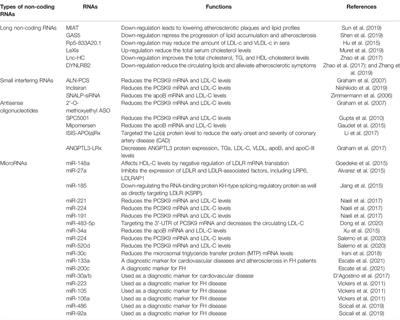
Regulatory Non-Coding RNAs in Familial Hypercholesterolemia, Theranostic Applications
Source : https://www.frontiersin.org/articles/10.3389/fcell.2022.894800/full
Familial hypercholesterolemia (FH) is a common monogenic disease which is associated with high serum levels of low-density lipoprotein cholesterol (LDL-C) and leads to atherosclerosis and cardiovascular disease (CVD). Early diagnosis...
Relevance: In this review, we briefly discussed the mechanisms and pathophysiology of FH and novel therapeutic strategies for the treatment of FH. Moreover, the theranostic effects of different non-coding RNAs for the treatment and diagnosis of FH were highlighted. Finally, the advantages and disadvantages of ncRNA-based therapies vs....
Share

absolute cardiovascular benefits of PCSK9 inhibitors and ezetimibe added to maximally tolerated statin therapy depend on individual baseline cardiovascular risk
Source : https://academic.oup.com/eurheartj/advance-article/doi/10.1093/eurheartj/ehac360/6631405?login=false
Comment on the article 'PCSK9 inhibitors and ezetimibe with or without statin therapy for cardiovascular risk reduction: a systematic review and network meta-an
Relevance: This systematic review and network meta-analysis of randomized controlled trials compared the impact of ezetimibe and proprotein convertase subtilisin/kexin type 9 inhibitors (PCSK9-i) on cardiovascular (CV) outcomes in patients taking maximally tolerated statin therapy or who were statin-intolerant.
Share
-
 Amy Gonzales, Physician3yrIn patents with high to very high-risk cardiovascular risk who are on maximal dose of statin that is tolerated, adding ezetimibe and PCS9-i is recommended to achieve beneficial effects.