
Remnant cholesterol and atherosclerotic cardiovascular disease: Metabolism, mechanism, evidence, and treatment
Source : https://www.frontiersin.org/articles/10.3389/fcvm.2022.913869/full
This review aimed to summarize the evidence of elevated remnant cholesterol and the risks of atherosclerotic cardiovascular disease (ASCVD) and to search for further guidance in clinical therapy. The lipids-lowering treatments such as statins and ezetimibe targeted on low-density lipoprotein cholesterol (LDL-C) have always been the first-line therapy for ASCVD.
Conclusions/Relevance: The use of statins, fibrates, APOC3 inhibitors, PCSK9 inhibitors, and omega-3 fatty acids to reduce RC levels in the plasma may provide long-term benefits. However, the standardized detection of RC was still controversial, and more studies on appropriate treatments of elevated RC are urgently needed. These positive trials may benefit more patients at high ASCVD risks worldwide in the future.
Share




• Source: Frontiers in Cardiovascular Medicine
• Relevance: “The review aimed to summarize the evidence of elevated RC and the risks of ASCVD, and to search for further guidance in clinical therapy.”
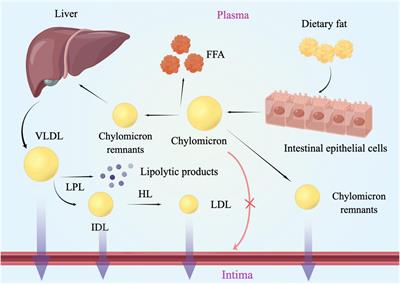
• Increased triglyceride (TG) levels signals that there is an increase in chylomicron (CM) or very-low-density lipoprotein (VLDL) particles (i.e., triglyceride-rich remnant lipoprotein particles or RLPs).
• RLPs are an emerging atherogenic risk factor per the American Heart Association. The authors defined TRLs as chylomicron remnants in the non-fasting state and VLDL/intermediate-density lipoprotein (IDL) in the fasting state. Studies have shown that it is remnant cholesterol—and not triglycerides—that predict poor ASCVD outcomes.
• Dyslipidemia was the main risk factor of ASCVD, per the authors. “Evidence from in vitro and animal pathogenic mechanisms studies, epidemiology, and genetic studies all indicated that RC plays an important role in predicting the incidence of ASCVD. As a new indicator to reflect atherosclerosis, especially when LDL-C has been controlled to a recommended level, RC was considered as a priority treatment target for people at high risk of ASCVD. Furthermore, stains were demonstrated to be effective in reducing cardiovascular disease and MACEs with few essential side effects.”
• APOC3 inhibitors, PCSK9 inhibitors, and omega-3 FAs to decrease RC levels could result in long-term positive outcomes. One issue is the standardized detection of RC, which is controversial.
• “Most desirable was a large, randomized placebo-controlled trial in patients with mild-moderately elevated TG with recommended controlled LDL-C, treated with a potent statin and another RC lowering drug. These positive trials may benefit more patients at high ASCVD risks,” the authors concluded.