


Associations Between Attention Deficit Hyperactivity Disorder Symptom Dimensions and Disordered Eating Symptoms in Adolescence: A Population-Based Twin Study - Behavior Genetics
Source : https://link.springer.com/article/10.1007/s10519-022-10128-5
Although bivariate associations between attention-deficit/hyperactivity disorder (ADHD) and eating disorders in adolescent girls and boys have been previously identified, the mechanistic link underlying the symptom-level associations remains unclear. We evaluated...
Conclusions/Relevance: As per our findings, the risk of comorbidity and shared genetics highlights the need for preventative measures and specialized treatment for ADHD and disordered eating in both sexes.
The importance of familial risk factors in children with ADHD: direct and indirect effects of family adversity, parental psychopathology and parenting practices on externalizing symptoms - Child and Adolescent Psychiatry and Mental Health
Source : https://capmh.biomedcentral.com/articles/10.1186/s13034-022-00529-z
Background Children experiencing unfavorable family circumstances have an increased risk of developing externalizing symptoms. The present study examines the direct, indirect and total effects of family adversity, parental psychopathology, and...
Conclusions: Family adversity, parental psychopathology, and negative parenting practices should be routinely assessed by clinicians and considered in treatment planning.

East asian herbal medicine for the treatment of children with attention deficit hyperactivity disorder: A Systematic Review and Meta-analysis
Source : https://www.sciencedirect.com/science/article/abs/pii/S1550830722002063?via=ihub
Available online 24 November 2022 Author links open overlay panel Ju Hyun Lee a Hee Geun Jo b Person d Envelope Sang Yeon Min Person c Envelope Show more Attention...
Conclusion: EAHM monotherapy has similar effects to CM but with fewer side effects. Hence, it will be helpful for children with ADHD suffering from the side effects of CM. EAHM-combined therapy has a better effect than conventional therapy. Accordingly, it will be useful for children with ADHD who do not respond to treatment with conventional...
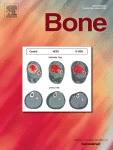
Combined methylphenidate and fluoxetine treatment in adolescent rats significantly impairs weight gain with minimal effects on skeletal development
Source : https://www.sciencedirect.com/science/article/abs/pii/S8756328222003143?via=ihub
Methylphenidate (MP) is frequently prescribed to treat Attention-Deficit/Hyperactivity Disorder (ADHD); however, many patients with ADHD experience depression and anxiety. As such, concomitant administration of selective serotonin reuptake inhibitors such as...
Conclusions/Relevance: These findings warrant further research into the effect of these drugs on weight gain, skeletal development and growth plate morphology, as well as consideration by physicians treating children and adolescents with ADHD.
ADHD symptoms and diurnal cortisol in adolescents: The importance of comorbidities
Source : https://www.sciencedirect.com/science/article/abs/pii/S0306453022003316?via=ihub
Altered regulation of diurnal cortisol has been associated with both dimensional symptoms and clinical diagnoses of attention deficit-hyperactivity disorder (ADHD). Indeed, a recent meta-analysis suggests that lower diurnal cortisol output...
Discussion: Our findings highlight the distinct influence of ADHD and externalizing symptoms on cortisol output. Further work is needed to examine the specificity of altered HPA-axis activity as a biomarker of ADHD and to elucidate whether symptoms of ADHD differ in their association with diurnal cortisol as a function of their severity.