


Epigenetics and ADHD: Reflections on Current Knowledge, Research Priorities and Translational Potential - Molecular Diagnosis & Therapy
Source : https://link.springer.com/article/10.1007/s40291-022-00609-y
Attention-deficit/hyperactivity disorder (ADHD) is a common and debilitating neurodevelopmental disorder influenced by both genetic and environmental factors, typically identified in the school-age years but hypothesized to have developmental origins beginning...
Conclusion: We conclude that the field of epigenetics and ADHD is promising but is still in its infancy, and the potential for transformative translational applications remains a distant goal. Nevertheless, rapid methodological advances, together with the rise of collaborative science and increased availability of high-quality, longitudinal...

Deciphering the Diversity of Mental Models in Neurodevelopmental Disorders: Knowledge Graph Representation of Public Data Using Natural Language Processing
Source : https://www.jmir.org/2022/8/e39888
Background: Understanding how individuals think about a topic, known as the mental model, can significantly improve communication, especially in the medical domain where emotions and implications are high. Neurodevelopmental disorders...
Conclusions: We show for the first time that generating KGs from web-based data can capture the complex needs of families dealing with ADHD or ASD. Moreover, we showed points of convergence between families and health professionals’ KGs.
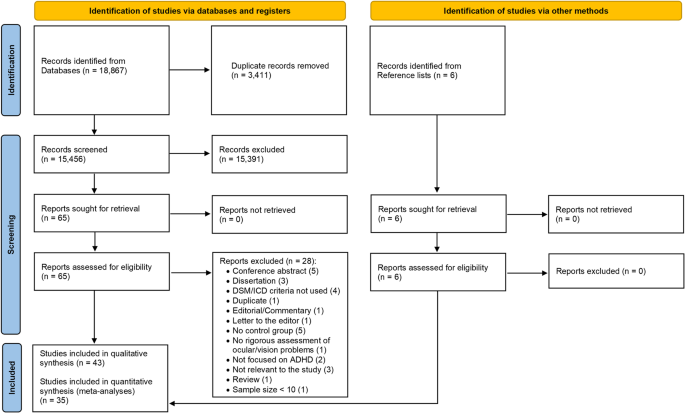
Association between ADHD and vision problems. A systematic review and meta-analysis - Molecular Psychiatry
Source : https://www.nature.com/articles/s41380-022-01699-0
To conduct the first systematic review and meta-analysis assessing whether attention-deficit/hyperactivity disorder (ADHD) is associated with disorders of the eye, and/or altered measures of visual function. Based on a pre-registered...
Discussion: ADHD is associated with some self-reported and objectively ascertained functional vision problems, but not with structural alterations of the eye. Further studies should clarify the causal relationship, if any, between ADHD and problems of vision.

Neuropsychiatric risk in children with intellectual disability of genetic origin: IMAGINE, a UK national cohort study
Source : https://www.thelancet.com/journals/lanpsy/article/PIIS2215-0366(22)00207-3/fulltext
Children with genomic variants and intellectual disability are at an increased risk of neuropsychiatric difficulties. CNV variant inheritance and socioeconomic deprivation also contribute to the risk. Early genomic investigations of...
Interpretation: Children with genomic variants and intellectual disability are at an increased risk of neuropsychiatric difficulties. CNV variant inheritance and socioeconomic deprivation also contribute to the risk. Early genomic investigations of children with intellectual disability could facilitate the identification of the most vulnerable...

Oral, intranasal, and intravenous abuse potential of serdexmethylphenidate, a novel prodrug of d-methylphenidate
Source : https://www.tandfonline.com/doi/full/10.1080/03007995.2022.2076474
Abstract Abstract Serdexmethylphenidate (SDX) chloride (Cl) is a novel prodrug of d-methylphenidate (d-MPH). These studies evaluated the abuse potential of SDX Cl when administered orally, intranasally (IN), and intravenously (IV)....
Conclusions: These findings indicate that the novel d-MPH prodrug, SDX, has lower abuse potential than d-MPH and support its classification as a C-IV controlled substance.
-
ADHD Connect4yrKey Points • Source: Current Medical Research and Opinion • Conclusion: “These findings indicate that the novel d-MPH [d-methylphenidate] prodrug, SDX [serdexmethylphenidate], has lower abuse potential than d-MPH and support its classification as a Show More