


Menopause Transition and Cardiovascular Disease Risk
Source : https://pubmed.ncbi.nlm.nih.gov/38555760/
The risk of cardiovascular disease (CVD) notably increases in the fifth decade of a woman's life, coinciding with the onset of menopause and occurring 10 years later than the similar...
Menopause-related symptoms such as vasomotor symptoms, sleep disturbances, and mood changes may all have a direct impact on CVD risk.
Share





Treating Moderate-to-Severe Menopausal Vasomotor Symptoms With Fezolinetant: Analysis of Responders Using Pooled Data From Two Phase 3 Studies (SKYLIGHT 1 and 2)
Source : https://pubmed.ncbi.nlm.nih.gov/38626380/
Fezolinetant was associated with significantly higher within-patient clinically meaningful improvement in important PRO, including VMS frequency, PROMIS SD SF 8b Total Score, MENQoL Total Score, and MENQoL VMS Domain Score.
Greater proportions of fezolinetant-treated versus placebo-treated participants had ≥50%, ≥75%, ≥90%, or 100% reduction in vasomotor symptom frequency from baseline to weeks 4 and 12.
Share

The Impact of Water Pollution on the Health of Older People
Source : https://pubmed.ncbi.nlm.nih.gov/38555759/
Water pollution exerts a negative impact on the health of both women and men, inducing hormonal changes, accelerating aging, and consequently leading to the premature onset of age-related health problems....
Exposure to specific pollutants may promote premature menopause and vasomotor symptoms, elevate the risk of CVD, and reduce bone density.
Share

The Influence of Habitual Physical Activity and Sedentary Behavior on Objective and Subjective Hot Flashes at Midlife
Source : https://pubmed.ncbi.nlm.nih.gov/38530999/
These data provide support for relations between sedentary time, physical activity, and hot flashes and highlight the importance of using objective and subjective assessments to better understand the 24-hour hot...
Replacing 1 hour of sitting with 1 hour of vigorous activity was associated with a 100% increase in subjectively reported but not objectively measured waking hot flashes.
Share
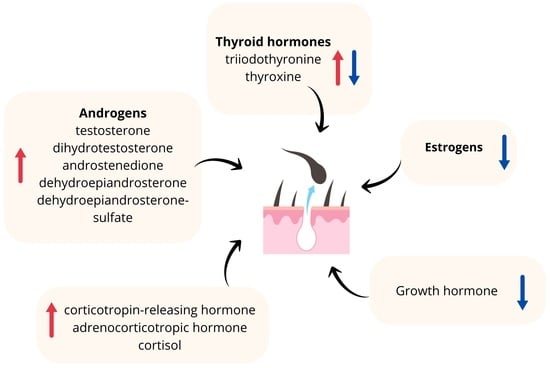
The Hormonal Background of Hair Loss in Non-Scarring Alopecias
Source : https://www.mdpi.com/2227-9059/12/3/513
Hair loss is a common clinical condition connected with serious psychological distress and reduced quality of life. Hormones play an essential role in the regulation of the hair growth cycle....
Hair loss may occur in the case of estrogen deficiency, appearing naturally during menopause.
Share