

Once-Weekly Semaglutide in Adolescents with Obesity - PubMed
Source : https://pubmed.ncbi.nlm.nih.gov/36322838/
The .gov means it's official. Federal government websites often end in .gov or .mil. Before sharing sensitive information, make sure you're on a federal government site. The site is secure....
Relevance: We were impressed that at week 68 the difference between the semaglutide group and the placebo group in the change in body-mass index was −16.7 percentage points and in body weight was −17.4 percentage points.
Share




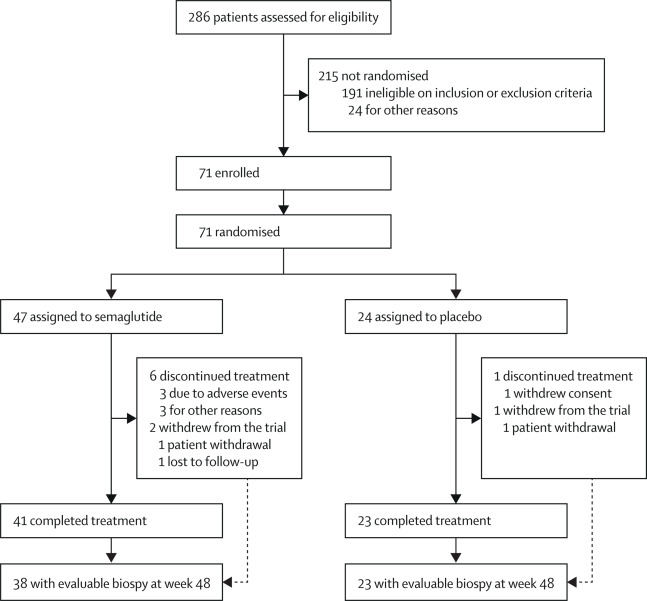
Semaglutide 2·4 mg once weekly in patients with non-alcoholic steatohepatitis-related cirrhosis: a randomised, placebo-controlled phase 2 trial
Source : https://www.thelancet.com/journals/langas/article/PIIS2468-1253(23)00068-7/fulltext
Patients with non-alcoholic steatohepatitis (NASH)-related cirrhosis are at particularly high risk of developing potentially life-threatening liver-related morbidities, such as portal hypertension, hepatic decompensation, hepatocellular carcinoma, liver-related mortality, and cardiovascular events.,...
Interpretation: In patients with NASH and compensated cirrhosis, semaglutide did not significantly improve fibrosis or achievement of NASH resolution versus placebo. No new safety concerns were raised.
Share
Weight loss breaks the bond between nonalcoholic fatty liver disease and cardiovascular diseases: A clinical and epidemiological perspective - PubMed
Source : https://pubmed.ncbi.nlm.nih.gov/36951144/
Nonalcoholic fatty liver disease (NAFLD) is a growing health concern that is closely related to obesity and metabolic syndrome. In particular, NAFLD has been increasingly reported in adolescents and young...
Conclusions/Relevance: Besides the widespread use of bariatric surgery, the development of new GLP-1 agonists and GLP-1 GIP agonists revolutionized the treatment of obesity in recent years. Here, we discuss the interwoven correlation between obesity, NAFLD, and CVD and the benefits of weight-lowering approaches.
Share
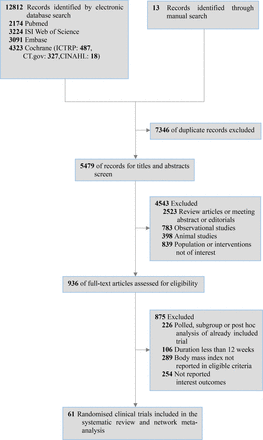
Efficacy and safety of GLP-1 receptor agonists versus SGLT-2 inhibitors in overweight/obese patients with or without diabetes mellitus: a systematic review and network meta-analysis
Source : https://bmjopen.bmj.com/content/13/3/e061807
Objective To compare the efficacy and safety between and within glucagon-like peptide-1 receptor agonists (GLP-1RAs) and sodium-glucose cotransporter 2 inhibitors (SGLT-2is) in overweight or obese adults with or without diabetes...
Conclusions: Semaglutide 2.4 mg showed the greatest effects on losing body weight, controlling glycaemic level and reducing blood pressure while it was associated with high risk of adverse events.
Share
Effect of once-weekly subcutaneous semaglutide 2.4 mg on weight- and health-related quality of life in an East Asian population: Patient-reported outcomes from the STEP 6 trial - PubMed
Source : https://pubmed.ncbi.nlm.nih.gov/36905345/
We assessed the effect of semaglutide 2.4 and 1.7 mg versus placebo on weight-related quality of life (WRQOL) and health-related quality of life (HRQOL) in the STEP 6 trial. Adults...
Conclusion: Overweight and obesity can have a negative impact on WRQOL and HRQOL. Our results demonstrate that in people from East Asia with overweight or obesity, treatment with once-weekly subcutaneous semaglutide 2.4 mg, in addition to a reduced caloric diet and increased physical activity, improved aspects of WRQOL and HRQOL,...
Share
-
 Endocrinologist Nation3yrKey Points • Source: Clinical Obesity • Conclusions/Relevance: “Treatment with semaglutide 2.4 mg improved aspects of WRQOL [work-related quality of life] and HRQOL [health-related quality of life] in people from East Asia with overweight/obesity.” • In Show More