

Managing Atherosclerotic Cardiovascular Risk in Young Adults: JACC State-of-the-Art Review
Source : https://www.sciencedirect.com/science/article/abs/pii/S0735109721084448?via=ihub
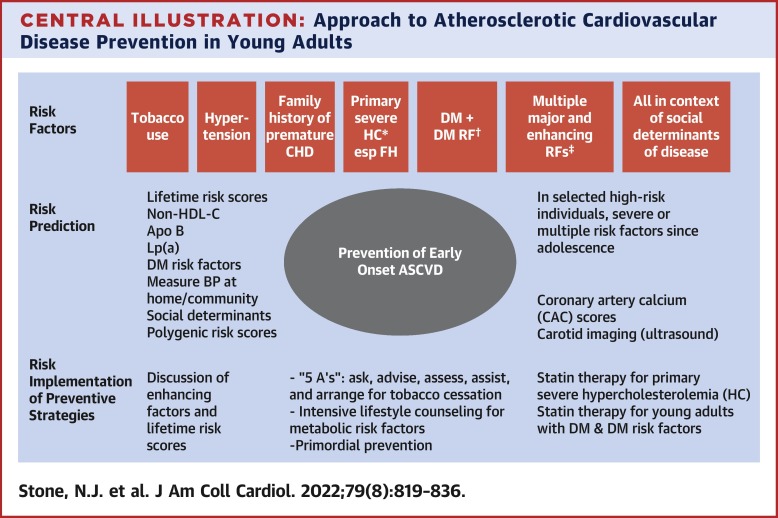
Addressing risk factors in individuals aged 20-39 years can reduce premature atherosclerotic cardiovascular disease. * Tobacco cessation and managing hypertension, hypercholesterolemia, diabetes, sex-specific risk factors, and metabolic syndrome are essential....
Relevance: The authors update current thinking on lipid risk factors such as triglycerides, non–high-density lipoprotein cholesterol, apolipoprotein B, or lipoprotein (a) that are useful in understanding an individual’s long-term ASCVD risk. The authors review emerging strategies, such as coronary artery calcium and polygenic risk scores...
Share





Pharmacological treatment with lipid-lowering agents after molecular identification of familial hypercholesterolemia: results from the Hipercol Brasil cohort - PubMed
Source : https://pubmed.ncbi.nlm.nih.gov/35181259/
Index cases with a positive genetic result increase their prevalence of lipid-lowering medication use. Positive relatives did not have the expected adherence; we could notice a significant increase in the...
Conclusion: Index cases with a positive genetic result increase their prevalence of lipid-lowering medication use. Positive relatives did not have the expected adherence; we could notice a significant increase in the prevalence of treatment starting after a positive genetic test. The independent predictors for lipid-lowering treatment were...
Share

Clinical decision support for familial hypercholesterolemia (CDS-FH): Rationale and design of a cluster randomized trial in primary care
Source : https://www.sciencedirect.com/science/article/pii/S000287032200031X?via=ihub
Familial hypercholesterolemia (FH) is an underdiagnosed and undertreated genetic disorder with high risk of premature atherosclerotic cardiovascular disease and death. Clinical decision support (CDS) systems have the potential to aid...
Conclusion: Despite increasing awareness of FH, the condition remains underdiagnosed and undertreated. The present study will investigate whether a CDS can increase the number of patients being diagnosed with FH.
Share

Low density lipoprotein cholesterol levels exceed the recommended European threshold for PCSK9i initiation: lessons from the HEYMANS study - PubMed
Source : https://pubmed.ncbi.nlm.nih.gov/35175350/
Across Europe, LDL-C levels at evolocumab initiation were three times higher than recommended thresholds for PCSK9i initiation, reflecting disparities between implementation and guidelines. More patients attained risk-based LDL-C goals when...
Conclusions: Across Europe, LDL-C levels at evolocumab initiation were three times higher than recommended thresholds for PCSK9i initiation, reflecting disparities between implementation and guidelines. More patients attained risk-based LDL-C goals when receiving evolocumab in combination with LLT versus those not receiving combination...
Share
Effects of preconception lifestyle intervention in infertile women with obesity: The FIT-PLESE randomized controlled trial
Source : https://journals.plos.org/plosmedicine/article?id=10.1371/journal.pmed.1003883
Richard S. Legro, Karl R. Hansen, Michael P. Diamond, Anne Z. Steiner, Christos Coutifaris, Marcelle I. Cedars, Kathleen M. Hoeger, Rebecca Usadi, Erica B. Johnstone, Daniel J. Haisenleder Subject Areas...
Conclusions: A preconception intensive lifestyle intervention for weight loss did not improve fertility or birth outcomes compared to an exercise intervention without targeted weight loss. Improvement in metabolic health may not translate into improved female fecundity.
Share
-
 Dr Hamid4yrImprovement in metabolic health Should be discussed with women
 -
Michelle Jardine4yrI see so many obese women with problems with fertility and often with weight loss and control of their obesity taking conceive