

No association between APOE genotype and lipid lowering with cognitive function in a randomized controlled trial of evolocumab - PubMed
Source : https://pubmed.ncbi.nlm.nih.gov/35404972/
APOE encodes a cholesterol transporter, and the ε4 allele is associated with higher circulating cholesterol levels, ß-amyloid burden, and risk of Alzheimer's disease. Prior studies demonstrated no significant differences in...
Conclusion/Relevance: In the subset of participants who underwent objective cognitive testing with the CANTAB, APOE genotype did not significantly modify the relationship between treatment arm and CANTAB performance after adjustment for demographic and medical covariates, (p's>.05). Although analyses were limited by the low population...
Share




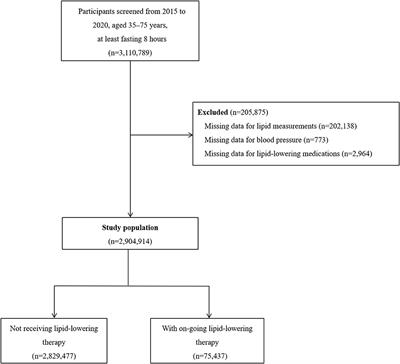
Atherosclerotic Cardiovascular Disease Risk and Lipid-Lowering Therapy Requirement in China
Source : https://www.frontiersin.org/articles/10.3389/fcvm.2022.839571/full
BackgroundLipid-lowering therapy (LLT) is one of the key strategies for reducing the atherosclerotic cardiovascular disease (ASCVD) burden. However, little is known about the percentage of people in need of different...
Conclusions: Moderate-intensity statin therapy is pivotal for the attainment of optimal LDL-C goals in China, and around 10–25% of high- or very-high-risk patients would require additional non-statin agents. There is an opportunity to reduce the rising ASCVD burden in China by optimizing LLT.
Share

Motivating cascade testing for familial hypercholesterolemia: applying the extended parallel process model for clinician communication - PubMed
Source : https://pubmed.ncbi.nlm.nih.gov/35429393/
Motivating at-risk relatives to undergo cascade testing for familial hypercholesterolemia (FH) is critical for diagnosis and lifesaving treatment. As credible sources of information, clinicians can assist in family communication about...
Conclusion/Relevance: Guided by the extended parallel process model (EPPM), we analyzed the perspectives of individuals and families with FH for effective messaging clinicians can use to promote cascade testing uptake. We analyzed narrative data from interviews and surveys collected as part of a larger mixed-methods study. The EPPM was used to...
Share

Latest clinical evidence about the effect of PCSK9 monoclonal antibodies in patients with familial hypercholesterolaemia: an updated meta-analysis | Zhang | Endokrynologia Polska
Source : https://journals.viamedica.pl/endokrynologia_polska/article/view/84675
Early publication date: 2022-02-14 Qiongfang Zhang 1, Lianxiang Deng 1, Cong Chen 1, Xu Pan 1, Shan Jiang 1 DOI: 10.5603/EP.a2021.0109 Endokrynol Pol 2022;73(1):110-120. The Second People's Hospital of Nanning,...
Conclusions: Overall, PSCK9 mAbs are an effective and safe method of LDL-C reduction in patients with FH.
Share
The Role of Non-statin Lipid-Lowering Medications in Youth with Hypercholesterolemia - Current Atherosclerosis Reports
Source : https://link.springer.com/article/10.1007/s11883-022-01013-x
Purpose of Review Lifestyle modification is additive to lipid-lowering medications in the treatment of heterozygous familial hypercholesterolemia (HeFH), which does not respond sufficiently to statin therapy. While both are also...
Summary: Approvals for PCSK9 and ANGPTL3 inhibitors have expanded opportunities for children and adolescents with HeFH and HoFH to achieve lower LDL-C levels.
Share