

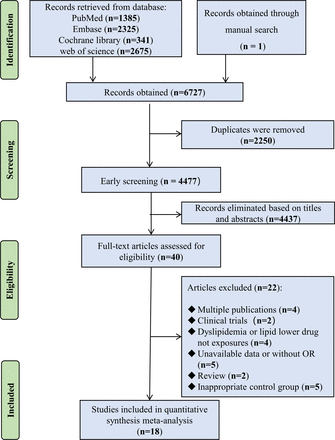
Association Between Dyslipidaemia and Dry Eye Disease: a Systematic Review and Meta-Analysis
Source : https://bmjopen.bmj.com/content/13/11/e069283.long
PubMed, Embase, Web of Science and Cochrane Library were systematically searched from January 2000 to December 2021. We included observational studies to assess the correlation of DED with meibomian gland...
A history of lipid-lowering drug use was positively correlated with a significantly increased risk of dry eye disease.
Share





Bempedoic Acid - How Will it Shape the Future Lipid-Lowering Landscape? Mode of Action, Evidence, and Clinical Use
Source : https://pubmed.ncbi.nlm.nih.gov/37989119/
Background Low density lipoproteins are now proven to be causal for atherosclerosis. Pharmacological treatment focuses on an increase of LDL receptors, particularly in the hepatocyte, which leads to uptake of...
BA alone and in combination with ezetimibe is excellent for the treatment of patients who are not at goal after either statin therapy or, if statins are not tolerated, after PCSK9-reducing therapy.
Share

Clinical Competence, Communication Ability and Adherence to Choosing Wisely Recommendations for Lipid Reducing Drug Use in Older Adults
Source : https://www.ncbi.nlm.nih.gov/pmc/articles/PMC10662284
Although lipid-lowering drugs are not recommended for primary prevention in patients 75+, prevalence of use is high and there is unexplained variation in prescribing between physicians.
More clinically competent physicians were more likely to prescribe lipid-lowering drug for primary prevention but only to patients aged 75 years or older.
Share

LOGAN-CV: A Prospective Study of a Multifaceted Intervention Targeting United States Clinicians to Improve Guideline-Based Management of Lipid-Lowering Therapy
Source : https://link.springer.com/article/10.1007/s12325-023-02716-6
The 2018 American Heart Association (AHA)/American College of Cardiology (ACC)/Multisociety blood cholesterol guidelines recommend clinicians consider adding non-statin therapy for patients with very high-risk (VHR) atherosclerotic cardiovascular disease (ASCVD) and...
The clinician education modules developed can help in overcoming clinical inertia, support clinicians in providing guideline-based LLT, and enable patients to achieve recommended LDL-C levels.
Share
Coronary and Extra-Coronary Subclinical Atherosclerosis to Guide Lipid-Lowering Therapy
Source : https://link.springer.com/article/10.1007/s11883-023-01161-8
The most robust evidence for the use of CAC scoring is in select individuals, 40-75 years of age, at borderline to intermediate 10-year ASCVD risk.
Identification of coronary calcium in selected patients is the single best noninvasive imaging modality to identify future ASCVD risk and inform lipid-lowering therapy decision-making.
Share