


Long-Term Mortality in Patients With Severe Hypercholesterolemia Phenotype From a Racial and Ethnically Diverse US Cohort
Source : https://pubmed.ncbi.nlm.nih.gov/37970713/
In a large, diverse cohort of US patients with the severe hypercholesterolemia phenotype, we identified several patient characteristics associated with increased 9-year all-cause mortality and observed a decrease in statin...
In a large, diverse cohort of US patients with the severe hypercholesterolemia phenotype, we identified several patient characteristics associated with increased 9-year all-cause mortality. A significant survival benefit was conferred by lipid-lowering therapy.
Share





Age-Dependent Association of Metabolic Dyslipidemia With Clinical Expression of Hypertrophic Cardiomyopathy
Source : https://pubmed.ncbi.nlm.nih.gov/37935337/
High triglyceride and low HDL-C levels are associated with a higher incidence of HCM, particularly in young individuals.
High triglyceride and low high-density lipoprotein cholesterol levels, the 2 dyslipidemia-related components of metabolic syndrome, are associated with a higher incidence of clinical HCM.
Share

High Residual Cardiovascular Risk After Lipid-Lowering: Prime Time for Predictive, Preventive, Personalized, Participatory, and Psycho-Cognitive Medicine
Source : https://www.ncbi.nlm.nih.gov/pmc/articles/PMC10613690/
As time has come to translate trial results into individualized medical diagnosis and therapy, we analyzed how to minimize residual risk of cardiovascular disease (CVD) by reviewing papers on "residual...
Digital medicine can aid to move forward towards P5 medicine, in terms of prediction through the collection of big data and AI, prevention through monitoring of patient characteristics, and personalized and participatory by involving the patient when carrying wearable devices.
Share

Characterization and LDL-C Management in a Cohort of High and Very High Cardiovascular Risk Patients: the PORTRAIT-DYS Study
Source : https://pubmed.ncbi.nlm.nih.gov/37933175/
We found that LDL-C control was very low in patients at higher risk of CV events. An alarming gap between guidelines on dyslipidemia management and clinical implementation persists, even in...
In this European study, poor LDL-C control was seen across all cohorts, with LDL-C goal attainment rates of 32%, 10%, and 18% for high-risk CV, ASCVD equivalent, and ASCVD cohorts, respectively.
Share
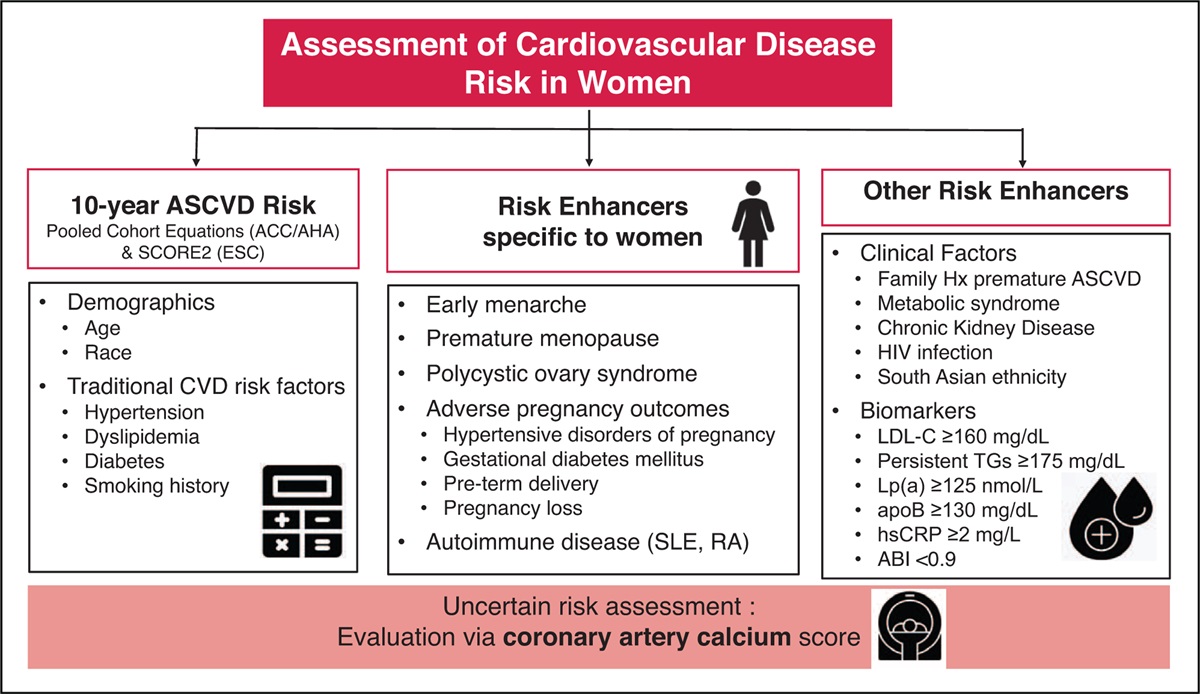
Cardiovascular Disease Prevention in Women – the Current State in 2023
Recent studies have demonstrated the need to account for risk factors specific to women in current risk assessment models for CVD, including early menarche, polycystic ovary syndrome, adverse pregnancy outcomes,...
At-risk women benefit similarly to lipid-lowering and other preventive therapies as men but are less likely to be treated.
Share