
Causal relationship between PCSK9 inhibitor and autoimmune diseases: a drug target Mendelian randomization study - Arthritis Research & Therapy
Source : https://arthritis-research.biomedcentral.com/articles/10.1186/s13075-023-03122-7
Background In addition to decreasing the level of cholesterol, proprotein convertase subtilis kexin 9 (PCSK9) inhibitor has pleiotropic effects, including immune regulation. However, the impact of PCSK9 on autoimmune diseases...
Conclusions: PCSK9 inhibitor significantly reduced the risk of SLE but increased the risk of asthma and CD. In contrast, HMGCR inhibitor may be a risk factor for RA, asthma, and CD.
Share




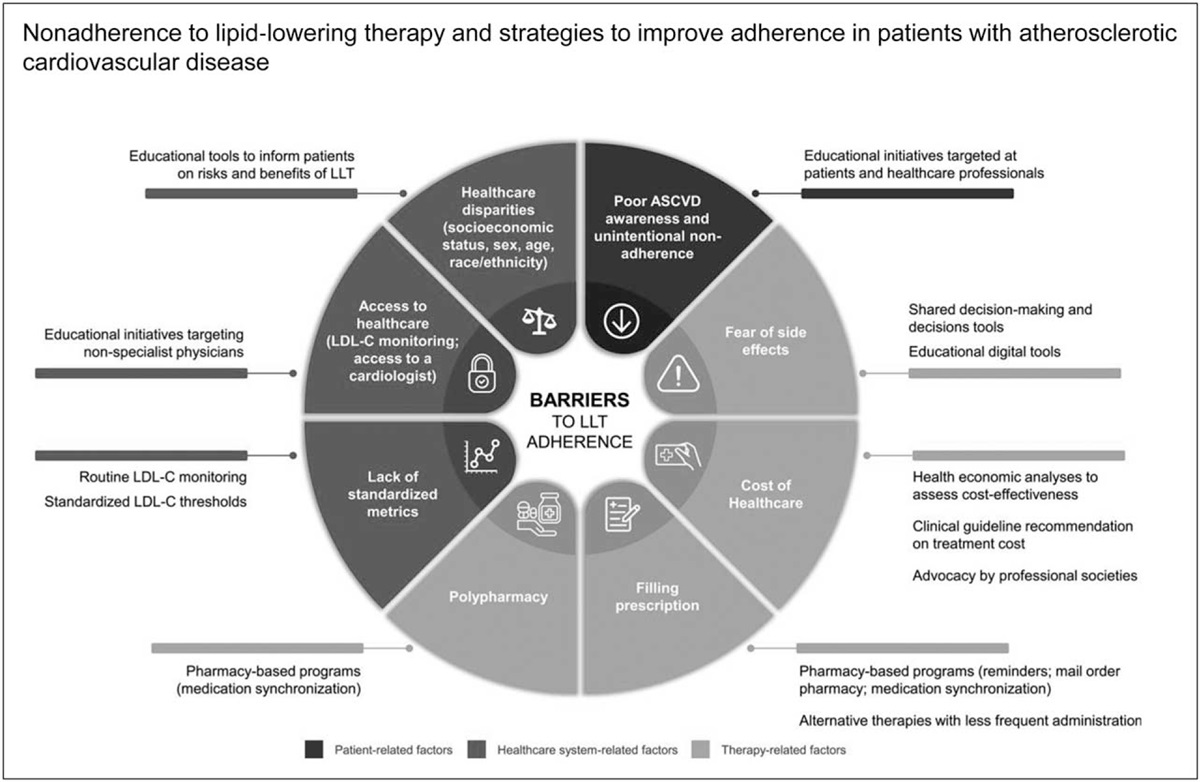
Strategies of improving adherence to lipid-lowering therapy in patients with atherosclerotic cardiovascular disease
Source : https://journals.lww.com/co-lipidology/abstract/9900/strategies_of_improving_adherence_to.45.aspx
agement in patients with ASCVD focusing on the provider, patient, and system level. Recent findings At a provider level, under-prescribing of statin intensity due most often to statin intolerance, clinical...
Summary: To improve cholesterol management in ASCVD patients will require an integrated approach targeting the provider, the patient and the system. There is a need for further education of clinicians on the importance of intensive LDL-C lowering in ASCVD patients and greater use of nonstatin LDL-C-lowering therapies for those patients on a...
Share
Targeting PCSK9 and Beyond for the Management of Low-Density Lipoprotein Cholesterol - PubMed
Source : https://pubmed.ncbi.nlm.nih.gov/37568484/
Reducing low-density lipoprotein cholesterol (LDL-C) levels is crucial to the prevention of atherosclerotic cardiovascular disease (ASCVD). However, many patients, especially those at very high ASCVD risk or with familial hypercholesterolemia...
Conclusions/Relevance: These strategies demonstrate significant LDL-C reductions and improved cardiovascular outcomes, offering potential for optimal LDL-C control and reduced ASCVD risk. By addressing the limitations of statin monotherapy, these approaches provide new management options for elevated LDL-C levels.
Share
Integrated omics approach for the identification of HDL structure-function relationships in PCSK9-related familial hypercholesterolemia - PubMed
Source : https://pubmed.ncbi.nlm.nih.gov/37550151/
Several metrics of anti-atherogenic HDL functionality are altered in FH-PCSK9 patients paralleled by distinct compositional alterations. These data provide a first-ever overview of the impact of GOF PCSK9 genetic variants...
Conclusion: Several metrics of anti-atherogenic HDL functionality are altered in FH-PCSK9 patients paralleled by distinct compositional alterations. These data provide a first-ever overview of the impact of GOF PCSK9 genetic variants on structure-function relationships in HDL.
Share
Case report: Intensive statin and PCSK-9 inhibitor combo reduces plaque volume and stenosis in ischemic stroke patient - PubMed
Source : https://pubmed.ncbi.nlm.nih.gov/37520968/
Intracranial atherosclerotic ischemic stroke dramatically impacts the quality of life among the elderly. Statins therapy has been proven to be effective in plaque stabilization and alleviation in patients with intracranial...
Conclusions/Relevance: Here we provide a case which was reported to suggest that a combination of Evolocumab and intensive statin therapy might reverse or alleviate symptomatic intracranial artery stenosis.
Share