

Home > Focus Areas > Heart Failure Connect > Post
  • Saved
Emphasizing early intervention in CKM syndrome

In 2023, the American Heart Association (AHA) defined a triad of comorbidities—type 2 diabetes mellitus, cardiovascular disease (CVD), and chronic kidney disease (CKD)—as cardiovascular-kidney-metabolic (CKM) syndrome. The AHA identified 4 stages of CKM syndrome as well as a “prestage” of 0 that focuses on prevention and preservation of cardiac health (Table).
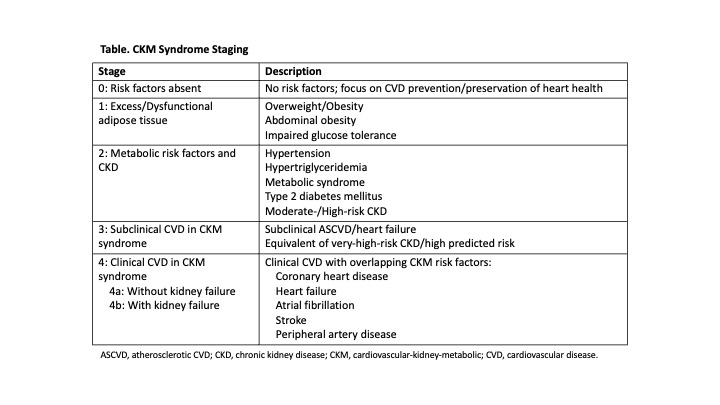
Table

The AHA’s staging model emphasizes the progressive pathophysiology of the disease. It also underscores the importance of early assessment and prevention as cornerstones of patient care—with early detection and interventions often resulting in larger clinical benefit—and it highlights stepwise increases in CVD risk in patients with later stages of the disease.

Several classes of drugs have shown benefit in preventing cardiovascular events, decreasing cardiovascular mortality, and delaying CKD progression. In particular, antidiabetic agents such as sodium-glucose cotransporter 2 inhibitors have cardioprotective effects and can help prevent renal failure.

What protective strategies do you use for your patients at risk for CKM syndrome? How do you facilitate early treatment interventions to avoid disease progression and mitigate the risks of CVD events and kidney failure?

  • 1yr
    One thing that is becoming clear is the role of inflammation and management of these parameters which create a hyper-inflammatory state. As such, optimization of diet (whole food plant base preferably) in conjunction with other lifestyle management is a good place to start. Addition of medications such as SGLT2 inhibitors certainly has a role. Unfortunately by the time I am seeing them they are frequently stage 3 or 4.
  • 1yr
    While prevention is important many patients come already with established disease. I enjoy when I can wear the “preventative “ hat and I can spent time discussing excercise, weight loss reducing alcohol, quitting smoking…these lifestyle treatments are often harder for patients to accomplish than by taking medications
  • 1yr
    Prevention is difficult for cardiologists, because by the time we see patient, they are already in stage 4. However, I think this framework is useful for education of PCPs and of patients, to emphasize healthy diet and regular exercise to prevent progression.
    Once patients develop frank disease, the framework is useful for emphasizing how heart disease, diabetes, and kidney disease are interlinked and helping focus attention on therapies (such as SGLT2 inhibitors) that address multiple elements of this triad.
  • 1yr
    I am thrilled with labeling of this entity as CKM syndrome. It goes beyond its historical precursor Metabolic Syndrome. For patients CKM syndrome highlights the high risks of developing cardiovascular, renal, and metabolic complications and hopefully motivates aggressive lifestyle changes while they are still stage 1 or 2. As a cardiologist I often don’t see the majority of these patients until they are stage 3 or 4. While I am likely to institute statins, GLP1 and possibly SGLT2 at that time, it is very important to intervene aggressively in earlier stages.
    This means weight loss and consideration of GLP1a to assist this for stage 1 patients. Also RAAS, statin, and possibly SGLT2 for stage 2 patients. The onus for early intervention falls on patients via a CKM awareness campaign and PCPs who see patients while they are stage 1 and 2.
  • 1yr
    Prevention and early understanding of risk factors for metabolic syndrome, CKD, HFpEF are key to improving cardiovascular health and outcomes for at-risk individuals. While no strategy fits all, personal attention and engagement of the individual about weight loss, dietary strategies and blood pressure control—as well as recognition and treating OSA—can go a long way in mitigating the CLM spectrum.
  • 1yr
    There are now stages for everything.
    The usefulness of this algorithm is that it resensitizes the clinical to the varied risk factors and their interconnectedness.
    How aggressive to be is a gestalt for me rather than a stage.
    A number of tools we use to treat known CAD, and known CHF, may seem logical to use earlier but may not be studied or approved as preventative care and certainly will not be covered by insurance
  • 1yr
    this construct is particularly helpful because it helps the clinician engage patients who are higher risk such as those with diabetes, obstructive sleep apnea and diastolic heart failure. this might facilitate a physician to incorporate SGLT2 inhibitors earlier in their treatment strategies.
    there is likely a continuum in this cardio metabolic renal insufficient penumbra, and the the best benefits are probably seen with earlier introduction of GMT.
  • 2yr
    Attention to prevention will fall on shoulders of PCPs. By the time I see patients they are at minimum Stage 2, many 3 and most Stage 4. Yet I do what is possible to try and alter their course.

    I speak to all of the patients about their condition and how underlying obesity and the insulin resistance will lead to a myriad of health issues. I encourage increase in daily activity, modification of diet to reduce processed foods and refined sugars/carbs.

    Blood work includes usual lipid panel, A1c, BNP, and hs-CRP. I stress the importance of systemic inflammation and its role in disease progression.

    Once lifestyle changes have been put into place along with educational sessions and sometimes intensive cardiac rehab, I identify what medications can help.

    This usually includes metformin, bupropion, metamucil, ACE, statins, SGLT2i, and now more and more GLP1-RAs.

    Identifying family members who are also at risk and implementing a household strategy leads to higher rate of success.

    Very tough problem overall for which lots of support and resources will be needed as we move forward.
  • 2yr
    Prevention (usually outside of cardiologists purview): Healthy lifestyle, exercise, limited processed food intake, weight loss. Perhaps GLP-1 drugs will help in this

    Early Treatment, when one part of the syndrome develops. Pharmacological therapy (SGLT2i, ACEI/ARB, BP management, DM management, statins) along with lifestyle changes. Would try to not be very intensive with medications early in hopes that lifestyle changes may still change the trajectory of the process

    Later treatment, sadly where most of the patients present. It is too late for lifestyle changes to be the only treatment. Intensive medications as listed above.
  • 2yr
    This is a very interesting situation which involves recognition and preemptive care. I tend to focus on SGLT2 inhibitors, ACEI/ARBs along with statins if the LDL > 70 mg/dL. By employing this strategy, I am lowering BP and cholesterol with disease modifying agents, thereby slowing or halting the progression of cardiac and renal disease. The use of a GLP-1 agonist can also be added but once the other pillars have been started.
  • 2yr
    Unfortunately, patients don't get to me until stage 4; I definitely agree that prevention is much better than treatment, when/if possible, through lifestyle and appropriate medications.
  • 2yr
    Risk factor modification is key. Start with healthy diet and exercise. It is paramount to control blood pressure. One can add SGLT2 inhibitors to decrease risk of CHF and worsening renal function. Also, can add GLP1 for weight loss, treatment of diabetes and to further decrease risk of MACE. Kerendia could also be added in diabetics with albuminuria or renal insufficiency.
  • 2yr
    Primary prevention to begin with - as usual. Lifestyle - diet/exercise/moderation of Etoh. GDMT; in particular SGLT2I (2 agents widely available) promising for this entity.
  • 2yr
    Strategies to protect patients who are at risk for CKM Syndrome include eating a healthy diet, being physically active, and managing blood pressure, cholesterol, and blood glucose very carefully. In addition, maintaining a healthy weight along with getting enough sleep and avoiding smoking can help protect against CKM Syndrome. Treatment with SGLT2 Inhibitors can have a definite cardioprotective effect, including a lower risk of cardiovascular death and decreased hospitalizations for CHF. These agents can also prevent progression to renal failure.
  • 2yr
    I emphasize a whole food plant based diet, which promotes weight loss and often reversal of Type 2 diabetes or metabolic syndrome. It also produces BP reduction. Exercise, stress reduction, and improved sleep habits and treatment of sleep apnea (if present) are helpful for CV risk reduction. If diabetic medication is indicated, early use of metformin and SGLT2 inhibitors or GLP1 agonists are preferred choices.
  • 2yr
    The CKM syndrome originates from excess adipose tissue that is dysfunctional resulting in insulin resistance and hyperglycemia.
    Inflammation, oxidative stress, insulin resistance, and vascular dysfunction drive the development of metabolic risk factors, progression of kidney disease, which potentiates the heart kidney interactions leading to cardiovascular disease. Metabolic risk factors and chronic kidney disease further predispose to cardiovascular diseases through multiple direct and indirect pathways.
    For the protective strategies at the primary prevention level of CKM syndrome, one should recommend:
    1. attaining and maintaining ideal CVH linked to decreased CVD.
    2. Multilevel school and family-based interventions.
    3. Avoiding weight gain/obesity
    4. Nonjudgmental weight loss counseling, comprehensive lifestyle intervention, use of incretin analogues (>10% weight loss is associated with lower CVD events) and in advance cases use of bariatric surgery.
    For stage 2 CKM patients, each contributing factors should be intervened namely,
    1. hypertension (goal 130/80, pharmacotherapy for those with diabetes, CKD, age>65, or ASCVD risk >10%; ACEi/ARB if CKD or diabetes with albuminuria)
    2. Hypertriglyceridemia (lifestyle change, statin if intermediate/high ASCVD risk; if diabtetes+triglycerides >135 mg/dl then icosapent ethyl therapy)
    3. MetS (lifestyle change/weight loss)
    4. Diabetes (statin +/- ezetimibe to achieve 50% LDL reduction, SGLT2inihbitors, GLP-1RA and metformin with SGLT2i if HBA1C >7.5%)
    5. CKD (ACEi/ARB in albuminuric CKD, SGLT2i in CKD with GFR>30 ml/min/ , Finerenone in CKD with diabetes with GFR >25 ml/min/ )
    The CKM stages 3 and 4 are advanced and treatment is targeted towards the same risk factors with an increasing amount of target organ damage.
  • 2yr
    use diet and lifestyle modification first; use frequently SGLT2 inhibitor Rx and occasionally GLP1 agonist for weight loss or consider bariatric surgery if BMI morbidly obese; aggressively use RAAS inhibition for renal protection and CHF/diastolic dysfunction
  • 2yr
    Prevention is the key. Emphasize lifestyle modification with healthy eating, regular exercise, reducing alcohol intake, no cigarette smoking etc. Obesity management with GLP-1 agonist drugs, preventing CKD with early use of SGLT-2 inhibitors and aldosterone synthase inhibitors etc. GDMT treatment for HF both preserved and reduced EF. Aggressive diabetic control should be pursued.
  • 2yr
    This syndrome is multifactorial. One has to start with a serious effort at life style modification including diet and exercise. Pharmacology will play a role as well with stabilization of the blood sugar, lipid profile and BP. Would recommend close follow up with involvement of a significant other. Obviously tobacco and ETOH abuse needs to be addressed as well as treatment of OSA if this exists.
  • 2yr
    Focusing on healthy lifestyle and optimizing medications to help delay progression are both extremely important to mitigate the progression of CKM syndrome. Options I would consider to facilitate early treatment include; referral to weight loss clinic with consideration for GLP-1 agonist, dietician counseling and encouragement of exercise. To mitigate further progression in patients with CKD, CVD and DM additional strategies would include management of HTN (with ACE-I, ARB or ARNI), use of Kerendia as appropriate in patients with CKD/DM and use of SGLT2i in all patients.
  • 2yr
    prevention is key. That includes better diabetic control, instantiating SGLT 2 inh very early on and encouraging compliance with all four GDMT in heart failure with reduced ejection fraction

Show More Comments