
micro-community-banner
 
  • Saved
Considering a combined approach

Methylphenidate is a classic treatment for ADHD in children. Its immediate-release (IR) form lasts between 2 and 4 hours, whereas long-acting, or extended-release (XR), lasts about 8 hours. On its own, immediate-release methylphenidate can be used as a bridge to help children with evening symptoms and homework completion, but this needs to be taken every 4 hours, thus resulting in multiple daily doses.


Systematic literature reviews found IR stimulants to be more widely misused or diverted than XR stimulants, which could be a factor in selecting long-acting treatments that do not need supplementation.


For which patients would it be appropriate to use IR formulations?


What are the key attributes (or benefits) of IR and XR formulations that you consider for individual patients?


  • 3yr
    Suggest trial methylphenidate may convert to dextroamphetamine later depending on response ,also consider long acting am immediate in afternoon or meds like clonidine on guanfacine etc fir resistant cases
  • 3yr
    Suggest trial methylphenidate may convert to dextroamphetamine later depending on response ,also consider long acting am immediate in afternoon or meds like clonidine on guanfacine etc fir resistant cases

Show More Comments

  • Saved
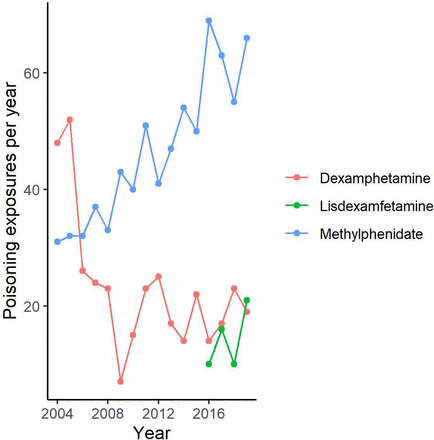
Poisonings with ADHD medication in children under the age of 5 years in Australia: a retrospective study, 2004-2019

Poisonings with ADHD medication in children under the age of 5 years in Australia: a retrospective study, 2004-2019

Source : https://bmjpaedsopen.bmj.com/content/6/1/e001325

Objective To describe the temporal relationships in attention-deficit hyperactivity disorder (ADHD) medication poisoning exposures in children; describe patient demographics, medications involved, poisoning exposure reasons and disposition. Design A population-based, retrospective...

Conclusions: ADHD medication use has increased, associated with an increased number of paediatric poisoning exposures. However, poisoning exposures per dispensed prescription has decreased. The majority of cases required hospitalisation, indicating the need for further poisoning prevention strategies.

  • Saved
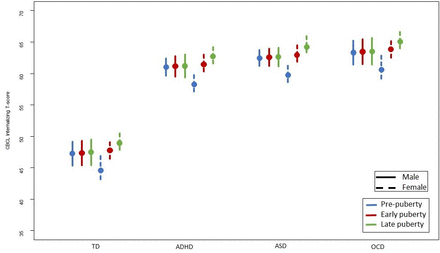
Pubertal stage, sex and behaviour in neurodevelopmental disorders versus typical development: a cross-sectional study

Pubertal stage, sex and behaviour in neurodevelopmental disorders versus typical development: a cross-sectional study

Source : https://bmjpaedsopen.bmj.com/content/6/1/e001469

Objective To determine the association between pubertal stage, sex and behavioural profile across and within neurodevelopmental disorders (NDDs) compared with typically developing (TD) youth. Methods This was a cross-sectional study...


Conclusions: Internalising/externalising patterns of behaviours across pubertal stages did not differ based on diagnosis. Pubertal females are at higher risk for internalising behaviours.


  • Saved
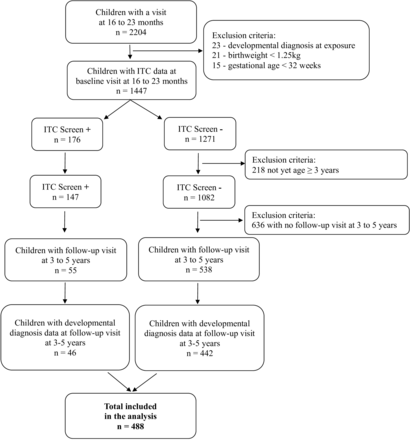
Predictive validity of the Infant Toddler Checklist in primary care at the 18-month visit and developmental diagnosis at 3-5 years: a prospective cohort study

Predictive validity of the Infant Toddler Checklist in primary care at the 18-month visit and developmental diagnosis at 3-5 years: a prospective cohort study

Source : https://bmjpaedsopen.bmj.com/content/6/1/e001524

Objective There is international variation in recommendations regarding developmental screening and growing recognition of the low sensitivity of commonly used developmental screening tools. Our objective was to examine the predictive...


Conclusions: The ITC had high specificity, high negative predictive value, low false positive rate, and identified children with later developmental delay and ASD. The ITC had low sensitivity, similar to other screening tools underscoring the importance of continuous developmental surveillance at all health supervision visits.

  • Saved
A Review of Canadian Diagnosed ADHD Prevalence and Incidence Estimates Published in the Past Decade - PubMed

A Review of Canadian Diagnosed ADHD Prevalence and Incidence Estimates Published in the Past Decade - PubMed

Source : https://pubmed.ncbi.nlm.nih.gov/36009114/

(1) Background: ADHD is recognized as one of the most common neurodevelopmental disorders. The worldwide prevalence of ADHD is estimated at 5.3%; however, estimates vary as a function of a...


Conclusions: The overall Canadian ADHD prevalence estimate is similar to worldwide estimates for adults. Most studies reported on prevalence rather than incidence. Differences in estimates across provinces may reflect the varying number of practitioners available to diagnose and prescribe medication for ADHD across provinces. To achieve a more...