


Menopause Connect
Profile Image
  • Saved


Discussion: The current state of communications may increase inequities in residency application processes; differences between faculty communications for applicants from different racial and ethnic backgrounds are particularly concerning given that program directors are more likely to weigh communications from faculty in their decision-making.

Profile Image
  • Saved
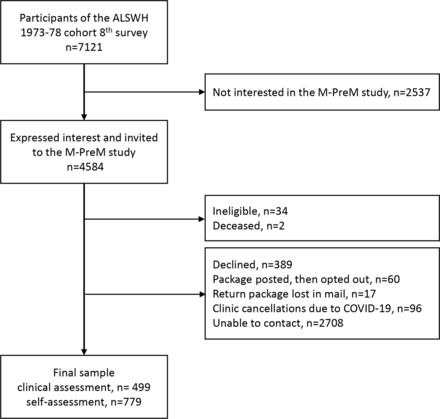
Cohort profile: a prospective Australian cohort study of women's reproductive characteristics and risk of chronic disease from menarche to premenopause (M-PreM)

Cohort profile: a prospective Australian cohort study of women's reproductive characteristics and risk of chronic disease from menarche to premenopause (M-PreM)

Source : https://bmjopen.bmj.com/content/12/10/e064333

Purpose Previous studies have identified associations between individual reproductive factors and chronic disease risk among postmenopausal women. However, few have investigated the association of different markers of reproductive function, their...


Conclusion: Compared with the participants who completed the self-assessment or did not participate in the M-PreM Study, in-clinic participants were more likely to be university educated and less likely to have three or more children, to ever have smoked or have a history of preterm birth. They also started having children at a later age....

Profile Image
  • Saved
Assessment of menopausal symptoms with changing hormone milieus in different menopausal transitional stages

Assessment of menopausal symptoms with changing hormone milieus in different menopausal transitional stages

Source : https://www.tandfonline.com/doi/abs/10.1080/07399332.2022.2134390?src=&journalCode=uhcw20

Abstract The present cross-sectional study is an attempt to evaluate menopausal symptoms with changing hormone milieus among women of different menopausal transitional stages. Out of all the symptoms, sexual dysfunction...


Conclusion: The present cross-sectional study is an attempt to evaluate menopausal symptoms with changing hormone milieus among women of different menopausal transitional stages. Out of all the symptoms, sexual dysfunction was the most commonly occurring symptom. Results of the correspondence analysis exhibited a significant association of...

Profile Image
  • Saved
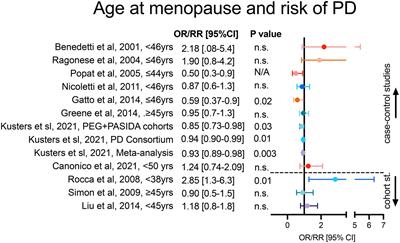
State-of-the-art review of the clinical research on menopause and hormone replacement therapy association with Parkinson's disease: What meta-analysis studies cannot tell us

State-of-the-art review of the clinical research on menopause and hormone replacement therapy association with Parkinson's disease: What meta-analysis studies cannot tell us

Source : https://www.frontiersin.org/articles/10.3389/fnagi.2022.971007/full

The menopause is a midlife endocrinological process that greatly affects women's central nervous system functions. Over the last 2 decades numerous clinical studies have addressed the influence of ovarian hormone...


Discussion: Several works support the hypothesis that menopause may constitute a triggering risk factor, which interaction with other risk factors and other possible pathological processes may modify the onset of PD.

Profile Image
  • Saved
Association of adverse pregnancy outcomes and multiple gestation with natural menopause: A population-based cohort study

Association of adverse pregnancy outcomes and multiple gestation with natural menopause: A population-based cohort study

Source : https://www.maturitas.org/article/S0378-5122(22)00219-5/fulltext

Early menopause, the cessation of ovarian function before the age of 45 years, affects approximately 10 % of women [1]. Women who experience early menopause are at increased risk of a nonfatal...


Conclusion: In this large cohort study, several statistically significant associations between APOs and age at natural menopause were observed. A deeper understanding of the relationships among APOs, menopause, and CVD is needed to help identify people at higher risk for early menopause and later CVD.

Profile Image
  • Saved
History of Previous Midlife Estradiol Treatment Permanently Alters Interactions of Brain Insulin-like Growth Factor-1 Signaling and Hippocampal Estrogen Synthesis to Enhance Cognitive Aging in a Rat Model of Menopause

History of Previous Midlife Estradiol Treatment Permanently Alters Interactions of Brain Insulin-like Growth Factor-1 Signaling and Hippocampal Estrogen Synthesis to Enhance Cognitive Aging in a Rat Model of Menopause

Source : https://www.jneurosci.org/content/42/42/7969

Across species, including humans, elevated levels of brain estrogen receptor (ER) α are associated with enhanced cognitive aging, even in the absence of circulating estrogens. In rodents, short-term estrogen treatment,...


Conclusion: Results indicate that short-term estrogen treatment following midlife loss of ovarian function has long-lasting effects on hippocampal function and memory by dynamically regulating cellular mechanisms that promote activity of ERα in the absence of circulating estrogens. Findings demonstrate how changes in hippocampal ERα...

Profile Image
  • Saved
Prediction of risk of depressive symptoms in menopausal women based on hot flash and sweating symptoms: a multicentre study

Prediction of risk of depressive symptoms in menopausal women based on hot flash and sweating symptoms: a multicentre study

Source : https://www.tandfonline.com/doi/full/10.2147/CIA.S148688

Abstract The present study aimed to develop a symptom-based (namely, hot flashes and sweating) scoring system for predicting the risk of depressive symptoms in menopausal women via a multicentre cross-sectional...


Discussion: The hot flash and sweating symptom-based scoring system developed to predict the risk of depressive symptoms in menopausal women relies on non-laboratory survey data. The system is simple, practical, and convenient to use.

Profile Image
  • Saved

made a Post

Recap of the 2022 North American Menopause Society Annual Meeting
More than 1 million women in the United States experience menopause each year, according to the National Institute on Aging. The North American Menopause Society (NAMS) 2022 Annual Meeting brought together the best and brightest minds in women’s health to discuss what is known about perimenopause, menopause, and postmenopausal health as well as what still needs to be learned.

The four-day meeting covered the treatment of vexing vasomotor symptoms with and without hormones, sleep disorders, and heart and bone health during menopause, with a focus on diversity. Click above for a post-conference wrap-up report.
Profile Image
  • Saved

made a Post

Recap of the 2022 North American Menopause Society Annual Meeting

More than 1 million women in the United States experience menopause each year, according to the National Institute on Aging. The North American Menopause Society (NAMS) 2022 Annual Meeting brought together the best and brightest minds in women’s health to discuss what is known about perimenopause, menopause, and postmenopausal health as well as what still needs to be learned.

The four-day meeting covered the treatment of vexing vasomotor symptoms with and without hormones, sleep disorders, and heart and bone health during menopause, with a focus on diversity. Click above for a post-conference wrap-up report.
Profile Image
  • Saved

made a Post

Recap of the 2022 North American Menopause Society Annual Meeting

More than 1 million women in the United States experience menopause each year, according to the National Institute on Aging. The North American Menopause Society (NAMS) 2022 Annual Meeting brought together the best and brightest minds in women’s health to discuss what is known about perimenopause, menopause, and postmenopausal health as well as what still needs to be learned.

The four-day meeting covered the treatment of vexing vasomotor symptoms with and without hormones, sleep disorders, and heart and bone health during menopause, with a focus on diversity. Click above for a post-conference wrap-up report.
Profile Image
  • Saved

made a Post

Recap of the 2022 North American Menopause Society Annual Meeting

More than 1 million women in the United States experience menopause each year, according to the National Institute on Aging. The North American Menopause Society (NAMS) 2022 Annual Meeting brought together the best and brightest minds in women’s health to discuss what is known about perimenopause, menopause, and postmenopausal health as well as what still needs to be learned.

The four-day meeting covered the treatment of vexing vasomotor symptoms with and without hormones, sleep disorders, and heart and bone health during menopause, with a focus on diversity. Click above for a post-conference wrap-up report.
Profile Image
  • Saved


Discussion: Ultimately, all menopause resources need to be made inclusive. We need doctors and other staff who are both affirming and knowledgeable of menopause and LGBTQIA experience.

Profile Image
  • Saved
A dietary intervention for vasomotor symptoms of menopause: a randomized, controlled trial - PubMed

A dietary intervention for vasomotor symptoms of menopause: a randomized, controlled trial - PubMed

Source : https://pubmed.ncbi.nlm.nih.gov/36253903/

doi: 10.1097/GME.0000000000002080. Online ahead of print. 1 Physicians Committee for Responsible Medicine, Washington, DC. 2 School of Medicine, University of Utah, Salt Lake City, UT. 3 Division of Pathology and...


Conclusion: A dietary intervention consisting of a plant-based diet, minimizing oils, and daily soybeans significantly reduced the frequency and severity of postmenopausal hot flashes and associated symptoms.

Profile Image
  • Saved
Estrogen enforces the integrity of blood vessels in the bone during pregnancy and menopause - Nature Cardiovascular Research

Estrogen enforces the integrity of blood vessels in the bone during pregnancy and menopause - Nature Cardiovascular Research

Source : https://www.nature.com/articles/s44161-022-00139-0

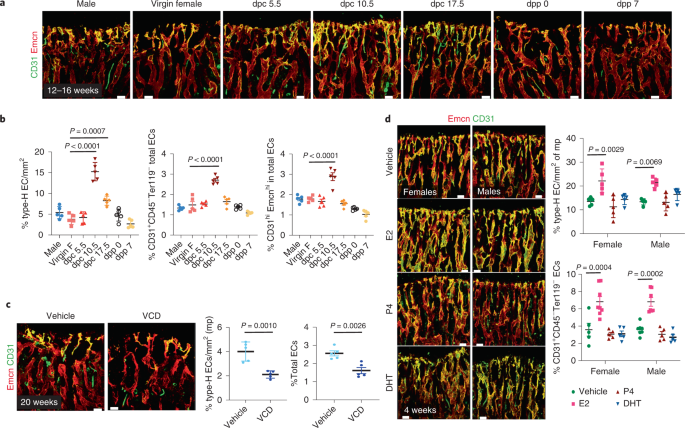
Rodrigues et al. show that estrogen levels regulate bone endothelial cell (BEC) physiology. Low levels of estrogens impair fatty acid metabolism in BECs and lipolysis of adipocytes and cause accumulation...


Discussion: Our findings demonstrate the effects of estrogen on BECs and suggest that LPO targeting could be an efficient strategy to manage blood and bone health in females.

Profile Image
  • Saved
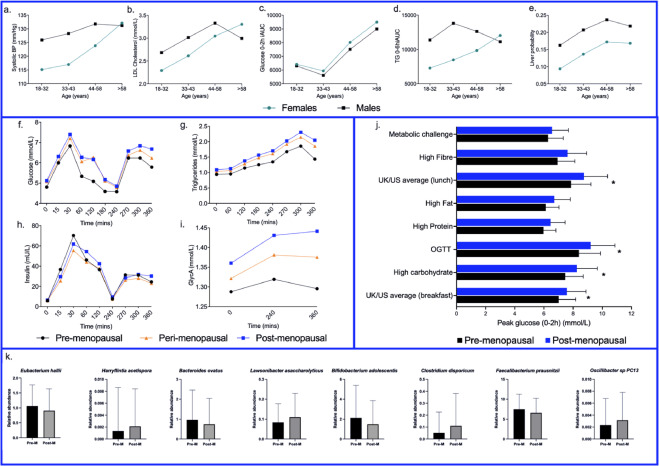
Menopause is associated with postprandial metabolism, metabolic health and lifestyle: The ZOE PREDICT study

Menopause is associated with postprandial metabolism, metabolic health and lifestyle: The ZOE PREDICT study

Source : https://www.thelancet.com/journals/ebiom/article/PIIS2352-3964(22)00485-6/fulltext

Research in context Women spend more than one-third of their lives in a post-menopausal state. Menopause is the definitive disappearance of menstruation due to the depletion of ovarian activity, occurring...


Discussion: Whilst this transition is inevitable, this analysis demonstrates that approaches can be taken to attenuate the adverse cardiometabolic sequelae, including a focus on modifiable factors, such as diet, microbiome and use of MHT in appropriate candidates.

Profile Image
  • Saved

made a Post

Highlights from the 2022 North American Menopause Society Annual Meeting

The North American Menopause Society (NAMS) 2022 Annual Meeting brought together the best and brightest minds in women’s health to share their current thinking on menopause and its management. The four-day meeting took place at the Hyatt Regency in Atlanta and covered hormone therapy, new non-hormonal treatments for vasomotor symptoms, bone health, heart health, mood and sleep, and sexuality.

Click above for a summary of the presentations that caught our attention at the conference.

Profile Image
  • Saved

made a Post

Highlights from the 2022 North American Menopause Society Annual Meeting

The North American Menopause Society (NAMS) 2022 Annual Meeting brought together the best and brightest minds in women’s health to share their current thinking on menopause and its management. The four-day meeting took place at the Hyatt Regency in Atlanta and covered hormone therapy, new non-hormonal treatments for vasomotor symptoms, bone health, heart health, mood and sleep, and sexuality.

Click above for a summary of the presentations that caught our attention at the conference.

Profile Image
  • Saved

made a Post

Highlights from the 2022 North American Menopause Society Annual Meeting

The North American Menopause Society (NAMS) 2022 Annual Meeting brought together the best and brightest minds in women’s health to share their current thinking on menopause and its management. The four-day meeting took place at the Hyatt Regency in Atlanta and covered hormone therapy, new non-hormonal treatments for vasomotor symptoms, bone health, heart health, mood and sleep, and sexuality.

Click above for a summary of the presentations that caught our attention at the conference.


  • Saved

made a Post

Highlights from the 2022 North American Menopause Society Annual Meeting

The North American Menopause Society (NAMS) 2022 Annual Meeting brought together the best and brightest minds in women’s health to share their current thinking on menopause and its management. The four-day meeting took place at the Hyatt Regency in Atlanta and covered hormone therapy, new non-hormonal treatments for vasomotor symptoms, bone health, heart health, mood and sleep, and sexuality.

Click above for a summary of the presentations that caught our attention at the conference.

Profile Image
  • Saved

made a Post

Treating Vasomotor Menopause Symptoms

Eighty percent (80%) of women aged 40-65 years reported having vasomotor menopausal symptoms (VMS) according to a survey of 4,754 women published in Menopause, The Journal of The North American Menopause Society. Vasomotor menopausal symptoms include hot flashes and night sweats or cold sweats. Insomnia, irritability, and trouble concentrating are additional symptoms often cited by patients.

Fifty-five percent (55%) of the surveyed women reported their vasomotor symptoms as moderate to severe, and more than half of these women were untreated. VMS has a substantial negative impact on women’s personal and professional lives, which increases with the severity of symptoms.

While hormone therapy is still widely used to treat VMS, there continue to be concerns about risks of venous thromboembolism, stroke, and breast cancer. According to the women surveyed, ~35% were hormone therapy-contraindicated and ~50% were hormone-therapy cautious or averse.

Have you seen similar statistics in your practice? What have you found to be successful in treating VMS with patients who are HRT-contraindicated or averse?

Profile Image
  • 3yr
    Since I am a Psych NP, I mainly use SSRI's and SNRI's which are somewhat effective for some. The numbers do seem similar to what I see.
  • 3yr
    Numerous studies have shown the strong correlation between VMS and endothelial dysfunction and increase rate of heart disease. I strongly disagree with treating symptoms.

Show More Comments